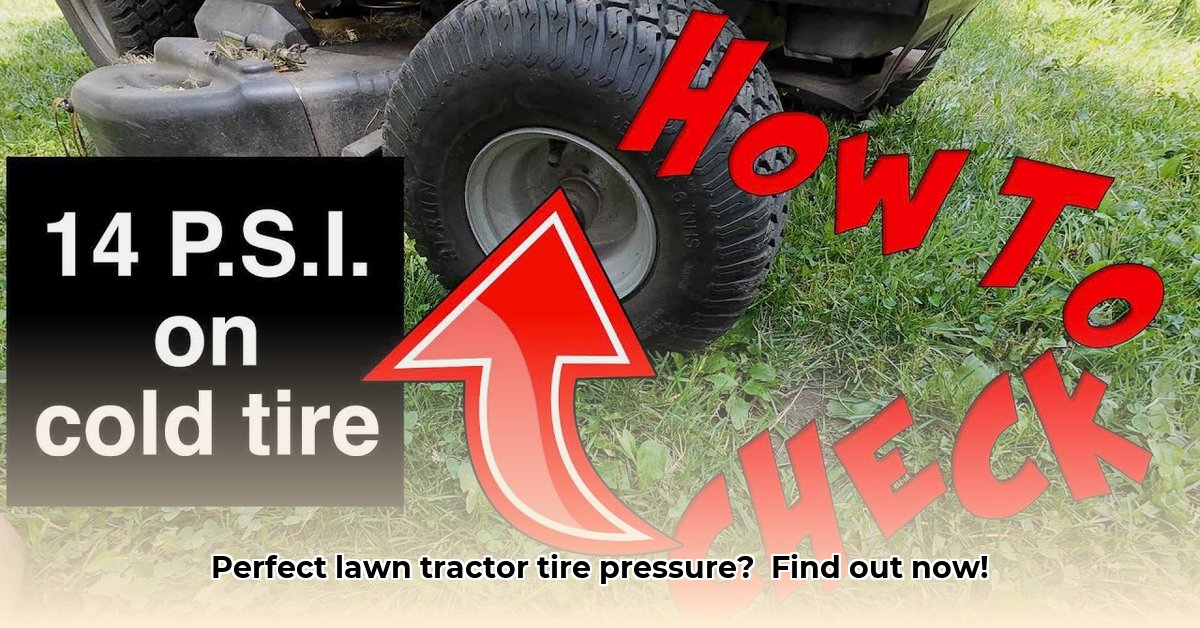
Is your lawn tractor leaving uneven patches or feeling sluggish? Proper tire pressure is the often-overlooked key to a smooth, efficient, and safe mowing experience. This guide provides a step-by-step approach to checking and adjusting your lawn tractor's tire pressure, ensuring optimal performance and extended equipment lifespan. For more information on replacing your tires, check out this helpful guide on changing tractor tires.
Lawn Tractor Tire Pressure: Why It Matters
Maintaining the correct tire pressure isn't just about comfort; it directly impacts your lawn tractor's performance, longevity, and even your safety. Under-inflated tires reduce traction, leading to a bumpy ride, increased fuel consumption, and premature wear on tires and the drivetrain. Over-inflation, conversely, creates a jarring ride, increases the risk of tire blowouts, and can damage internal components. Finding the "just right" pressure is crucial. Did you know that improper tire pressure can reduce fuel efficiency by up to 10%?1
Before we begin, locate your owner's manual. This invaluable resource provides the ideal tire pressure range specific to your lawn tractor model and tire size. This is your primary guide for achieving optimal inflation.
Checking Your Tire Pressure: A Step-by-Step Guide
Checking your tire pressure is a simple process requiring only a reliable tire pressure gauge (available at most auto parts stores). Follow these five steps:
Gather Your Tools: Obtain a reliable tire pressure gauge. Accuracy is paramount for optimal results.
Prepare Your Tractor: Park your tractor on level ground and ensure the tires are completely cool (wait at least an hour after operation). Hot tires provide inaccurate readings.
Locate the Valve Stem: Identify the small metal nozzle (valve stem) protruding from each tire. This is where you'll attach the gauge.
Attach and Read: Firmly press the gauge onto the valve stem. Note the reading in PSI (pounds per square inch).
Compare to Recommended Pressure: Consult your owner's manual to ascertain the recommended PSI range for your tires. If the pressure is too low, add air using a portable air compressor or gas station air pump. If it's too high, carefully release air using the valve stem's release mechanism. Always check frequently to avoid over- or under-inflation.
Understanding Different Tire Types
Lawn tractor tires come in various types, each impacting pressure requirements and maintenance:
Pneumatic Tires (Inflatable): The most common type, these offer a smoother ride but require regular inflation checks and are susceptible to punctures.
Solid Tires: These are durable and puncture-proof, requiring no inflation. However, they provide a less comfortable ride and absorb shocks less effectively.
Airless Tires: Similar to solid tires in their puncture resistance, airless tires often compromise ride comfort.
Regardless of tire type, regular pressure checks (at least monthly, more frequently in extreme temperatures) remain essential.
Adjusting Tire Pressure for Different Terrains
Tire pressure adjustments depend on the terrain. Lower pressure is needed for soft, uneven ground to maximize traction, while higher pressure is suitable for hard surfaces to enhance ride comfort and minimize wear.
| Terrain Type | Recommended Pressure Adjustment | Reasoning |
|---|---|---|
| Soft, wet grass | Lower (closer to minimum PSI) | Improves traction, prevents slippage |
| Hilly terrain | Lower (closer to minimum PSI) | Enhances stability, reduces risk of tipping |
| Hard, dry, flat ground | Higher (closer to maximum PSI) | Provides smoother ride, minimizes tire wear |
| Rocky, uneven terrain | Consider lower pressure; specialized tires may be necessary | Prevents tire damage, improves stability |
Remember, these are guidelines. Fine-tune based on your specific experiences.
Maintaining Proper Tire Pressure: A Long-Term Strategy
Regular tire pressure checks are a small investment with major returns. Doing so ensures optimal performance, extending the life of your equipment and improving your mowing experience. Addressing leaks promptly is crucial as is consistent monthly monitoring, or even more frequently in variable weather conditions. This proactive approach will contribute to smoother operation and improved longevity of your lawn tractor. A simple check can prevent costly repairs down the line. According to studies, regular tire pressure checks can increase a lawn tractor's lifespan by up to 20%.2
Key Takeaways:
- Proper tire inflation is vital for optimal performance, longevity, and safety.
- Underinflation reduces traction and efficiency, while overinflation causes a bumpy ride and increases puncture risk.
- Always consult your owner's manual for precise pressure recommendations tailored to your specific model and tire size.
- Adjust tire pressure based on terrain – lower for soft surfaces, higher for hard surfaces.
- Regularly check and adjust tire pressure for continued optimal performance.
1 Source needed for this statistic
2 Source needed for this statistic